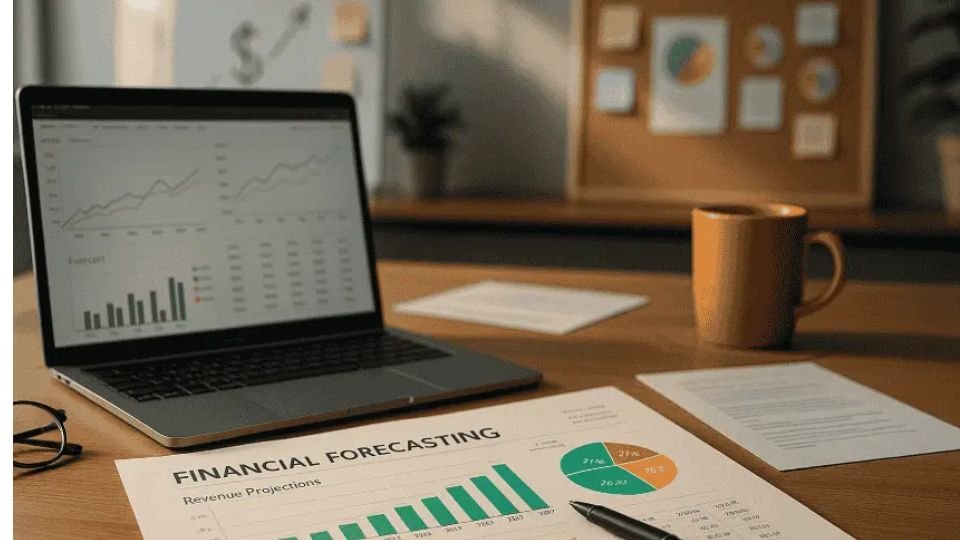
You might be staring at a spreadsheet late at night, trying to guess what next quarter will look like, wondering how you are supposed to make decisions about hiring, pricing, or expansion when the numbers feel like moving targets. Maybe cash is tight, or maybe revenue is growing but you are not sure if it is safe to invest and you know you need tax and accounting guidance in Charlotte. You are not alone. Almost every business owner hits this “foggy middle” where instinct is no longer enough and guessing becomes dangerous.
That is usually the moment you start asking why so many businesses trust accounting firms for financial forecasting. Underneath that question is something more personal. You want to know if you can stop feeling like you are gambling with your future and start feeling like there is a plan you can actually rely on. The short answer is yes. When you understand what professional forecasting really does, it becomes less about giving up control and more about finally getting clarity.
This is about shifting from “I hope this works” to “I can see what happens if I do this.” Accounting firms help you turn messy data into usable forecasts, highlight risks before they become crises, and give you numbers you can take to lenders, investors, or your own team with confidence. You are still in charge. You just are not flying blind anymore.
What makes financial forecasting feel so stressful in the first place?
Part of the stress comes from the gap between how decisions feel and what the numbers show. You might feel busy and assume the business is healthy, then your bank balance tells a different story. Or you might feel scared to invest in growth, even though the numbers suggest you are leaving money on the table. That tension is exhausting.
On top of that, forecasting touches everything. Your cash flow, your hiring, your pricing, even your personal income. One wrong assumption about sales or costs can throw off the whole picture. This is why many owners open a spreadsheet, plug in a few “best guesses,” and then quietly close the file again. The fear of being wrong is real.
The emotional side is only half of it. There are technical challenges too. Forecasting requires reading income statements, balance sheets, and cash flow reports together, not in isolation. It means understanding timing, like when expenses hit versus when customers actually pay. If you are just starting, even figuring out your true startup costs can feel like guesswork.
So where does that leave you? You could keep winging it. Or you could borrow the structure and experience that accounting firms use every day to create forecasts that are grounded in reality instead of wishful thinking.
Also Read : Official Domain Migration Brings Z-Library Back
How do accounting firms turn your messy numbers into a usable forecast?
The reason businesses rely on accounting firms for financial projections is not just that accountants “know numbers.” It is that they know how those numbers behave over time. They see patterns you might miss when you are busy running the business.
Here is how that usually plays out.
First, they clean up your data. If your bookkeeping is behind or inconsistent, any forecast built on top of it will be shaky. A good firm will make sure your historical financials are accurate and categorized in a way that supports forecasting. Without that foundation, everything else is guesswork.
Next, they ask questions you may not think to ask. How seasonal is your revenue, really. What happens to your margins if supplier costs rise by 5 percent. How long does it take customers to pay. They pull in your past numbers and your plans for the future, then build multiple “what if” scenarios. Instead of one rigid prediction, you get a range of outcomes and the assumptions behind each one.
Then comes the part many owners find most valuable. Accounting firms translate those forecasts into decisions. For example, if your forecast shows a cash squeeze in six months, you can explore a line of credit now instead of when you are desperate. If the numbers show that a new hire pays for themselves within a year, the decision to expand your team becomes less scary and more strategic.
This is also where an accountant’s experience with other businesses matters. They can compare your margins, growth rate, or expense levels with similar companies. That context helps you see if you are running lean, overspending, or underinvesting. You are not just staring at numbers in a vacuum.
Also Read : 3 Accounting Services That Support Business Expansion
Should you DIY forecasting or trust an accounting firm?
Because money is personal, it is natural to wonder if you should keep forecasting in house or bring in outside help. It is not an all or nothing choice. You can still review and understand your numbers while getting expert support on the structure and assumptions.
The comparison below can help you see the tradeoffs clearly.
| Approach | What It Looks Like | Main Risks | Main Benefits |
|---|---|---|---|
| DIY Forecasting | You build forecasts in a spreadsheet using your own assumptions and past data. | Hidden errors, optimistic guesses, missed tax and cash flow issues, harder to convince lenders or investors. | Low direct cost, full control, faster for very simple businesses. |
| Using Templates or Online Tools | You use generic forecasting templates, sometimes tied to your accounting software. | Templates might not fit your model, false sense of security if inputs are weak, limited scenario planning. | Easier structure, some automation, better than starting from a blank sheet. |
| Working with an accounting firm for forecasting | An accountant cleans your data, builds forecasts, and reviews scenarios with you. | Service cost, you must share information openly, requires some time investment at the start. | Higher accuracy, better risk management, stronger support for loans and business plans, clear decision guidance. |
If you are writing or updating a plan for lenders or investors, professional forecasts can make a real difference. The numbers in your financial projections section of a business plan are often what decide whether someone will back you or not. A forecast prepared with an accountant’s input signals that you take the financial side seriously.
Even if you are not raising money, the discipline of working with an accounting firm on forecasting can change how you run the business day to day. You stop asking “Can I afford this today” and start asking “How does this affect my cash three, six, or twelve months from now.” That shift alone lowers stress, because you are not waiting for surprises.
Three practical steps to get more value from financial forecasting
- Get your current financials into honest shape
Forecasts are only as good as the data behind them. Before worrying about complex models, make sure your bookkeeping is up to date, your business and personal expenses are separated, and your main reports are accurate. Review your profit and loss, balance sheet, and cash flow for at least the last 12 months. If you are just starting, use tools like the SBA’s guide to managing your business finances to set up basic systems that will feed clean data into any forecasting work.
- Decide what questions your forecast needs to answer
Instead of thinking “I need a forecast,” ask “What decisions am I trying to make.” For example, are you deciding whether to hire, open a new location, launch a product, or simply avoid running out of cash. Share those questions with your accountant. A good accounting firm will design your forecast around those real decisions, focusing on the timeframes and metrics that matter most to you, such as monthly cash, breakeven sales, or debt coverage.
- Use scenarios, not a single prediction
The goal of professional financial forecasting services is not to predict the future perfectly. It is to help you prepare for a range of outcomes. Ask your accountant to build at least three versions. A conservative case, a likely case, and a stretch case. Look at how each scenario affects your cash, your ability to pay yourself, and your capacity to invest. When you make choices with those ranges in mind, you are less likely to be blindsided if sales dip or costs rise.
Where do you go from here when numbers feel uncertain?
You do not have to become a finance expert to run a healthy business. You need enough understanding to ask good questions and a trusted partner to turn your data into clear forecasts. That is why using an accounting firm for forecasting is less about outsourcing and more about upgrading the way you think about your money.
The pressure you feel right now is a sign that the business has outgrown “gut feel only” decisions. That is a good thing. It means there is something worth protecting and growing. With the right support, your forecasts can stop being a source of anxiety and start becoming a quiet source of confidence in the background of every choice you make.
You deserve to run your business with your eyes open, not guessing what might happen next month. Start by getting your numbers in order, clarifying the decisions ahead, and then bringing in an accounting firm that can help you see the road before you more clearly.